
New DNA findings continue to challenge the historical records we have for many modern breeds. They help us to not only better understand horse genetic origins and relations, but also to better understand the human stories and roles which underlie it all. For us, this research is particularly exciting to recover more of the extraordinary historical influence of the Turkoman or Akhal-Teke horse.
It is now widely published and known that the foundational sires of the English Thoroughbred were of a specific haplotype that represents the Turkoman breed. The Darley Arabian, Godolphin Arabian, and Byerley Turk.
This haplotype also corresponds to a “700-year-old genetic mutation, sourced in one stallion or a family of closely related Turkoman stallions that found its way into the European horse population” (Mitchell, 2017). As a result, all modern breeds, with few exceptions, trace back to the same Turkoman halotype through the Y-chromosome.
Upon further research, Turkomans were distinguished genetically from Arabians as a northern ‘oriental’ population group while Arabians belong to a southern one. However, it is also “known that the Muniqui or Muniq’i strain of Arab were crossed with Turkoman during the 17th century, accounting for that Y-chromosome appearing through a southern oriental source” and further confusing the origin descriptions of these horses–particularly for the Darley and Godolphin “Arabian”s. (Rogers, 2019). Similar naming and descriptive record errors between Arabians and Turkoman horses would continue on, naming horses on the merits of their physical origin rather than true bloodlines, and this cemented in many narratives around the histories of each.
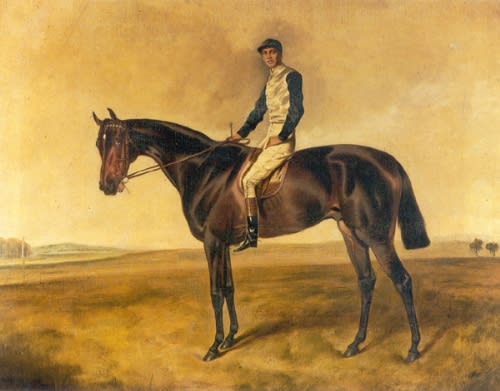
The latter research additionally revealed that one of the most famous racehorses and TB sires of all time, St Simon, and his sire Galopin descend not from the Darley Arabian but from the Byerley Turk. This not only impacts genetic research involving horses believed to come from the Darley Arabian through this lineage, but reassigns existing lines to have a higher concentration of the Byerley Turk. It suggests there may be more surviving males from this direct line than was previously thought and a greater influence of this line on the development of other modern breeds than was previously attributed.
St Simon had a massive impact on Thoroughbred and other sporthorse studbooks. He directly sired 423 foals, a quarter of which became stake winners, and his descendants are ever present in warmblood and jumper high-performance bloodlines. Now we know they trace back to the first Turkoman brought to England in 1684, the Byerley Turk (The Thoroughbred Link, 2025).
The Akhal-Teke, surviving descendants of the Turkoman, carries this genetic legacy and still appears even in recent refinement of other popular breeds including the Hanoverian and Trakehner. Genetic findings like this continue to further support their status as an invaluable heritage breed.
Each of the full scientific publications are linked in the referenced articles below.
Photo: Painting “The Duke of Portland’s bay colt ‘St. Simon’ with Fred Archer up” by John Arnold Wheeler, Wikimedia Commons.