

Since their domestication, horses have been pivotal in driving world economies, military pursuits, political maneuvers, and all manners of daily livelihood well into the 20th century. In many parts of the world, horses are still an essential component of agriculture, social and cultural identity. It is befitting that the influence of the horse should be honored on trade currencies across history, from coins to papers bills.
Of course, there is one horse that has been present since the beginning of equestrianism and continues to stand out as one of the most influential breeds of history: the Turcoman/Turk or Akhal-Teke.
Turk horses have been seen on a number of currencies and trade artifacts of different empires from ancient times to modern day—seen in Turkmen, Scythian, Medes, Persian, Ottoman, Greco-Roman, and even Chinese. This made ancient Turks drivers of the Silk Road both in horse trade and monies. Some designs are easier to identify than others, as they were known by many names, and some only have a few surviving recognizable pieces. This is a quick look at a few examples of Akhal-Tekes on currency.
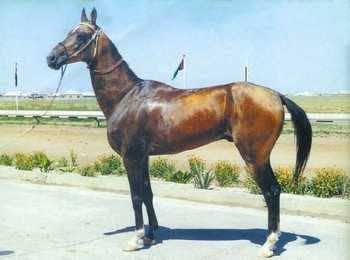
In the breed’s honor, the 1999 World Champion Akhal-Teke stallion Ýanardag bred by Geldy Kyarizov has lived on the Turkmen 50 manat-note since 2005. He has also been the feature of the Turkmenistan Coat of Arms since 2003. He displays the signature sooty golden buckskin coat color of the breed called “bulanaya”.
The Turk horse was also featured on coins from Turkiye, which was once heart of the Ottoman Empire where Turk horses were considered royal blood. On a commemorative 2014 1-lira from Turkiye was the Byerley Turk Horse. It was inspired by one of the key foundational Turk horses used in the early development of the English Thoroughbred, though the design appears to depict a heavier body type than other historical records.

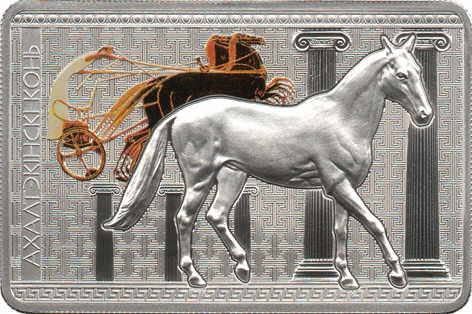
In Belarus, the Akhal-Teke can be seen in an ancient Greecian scene on the back of the 2011 commemorative 20 roubles rectangular coin.
The Akhal-Teke has even been seen on commemorative coins from the British Royal Mint, including a 2011 coin with two Akhal-Teke horses racing each other (and another appearance of Yanardag on the back).

The following are a couple additional interesting ancient finds with strong resemblance to Turk horses for discussion. Their identity is not confirmed, but they fit the breed for type, time, and place of their issuance to be depictions of the breed.
First is a coin from around 400 BCE, circulated under the Scythian King Sindi, when Scythian horsemen (and woman) rode ancient tall and swift Turk horses that gave the nomadic tribes decisive, unparalleled military advantage against their neighbors of the time. On this coin, the distinctive profile of the Turk horse can be observed with refined tappered head and elegant swan neck. Incredible to consider that their likeness has remained unchanged for millenia.

Finally, an ancient Chinese “ma bi” horse coin that often depicted great horses of Chinese history—of which some of the greatest came from the Fergana or “hanxue” Turk horses. They were made since the Song Dynasty but this particular coin is of unknown date. It portrays a slender necked, lithe horse of lore with an inscription that refers to riding 500km in a day, which aligns with the legendary endurance of the Fergana “Heavenly Horse”.

What do you think? Have you seen Turk/Akhal-Teke horses on other currency?
Info and photos for educational purposes from [in order]: the Central Bank of Turkmenistan, Geldy.co.uk, Tolnomur, In the World of Coins, Ehobbex, Wildwinds Ltd, and Primaltrek.