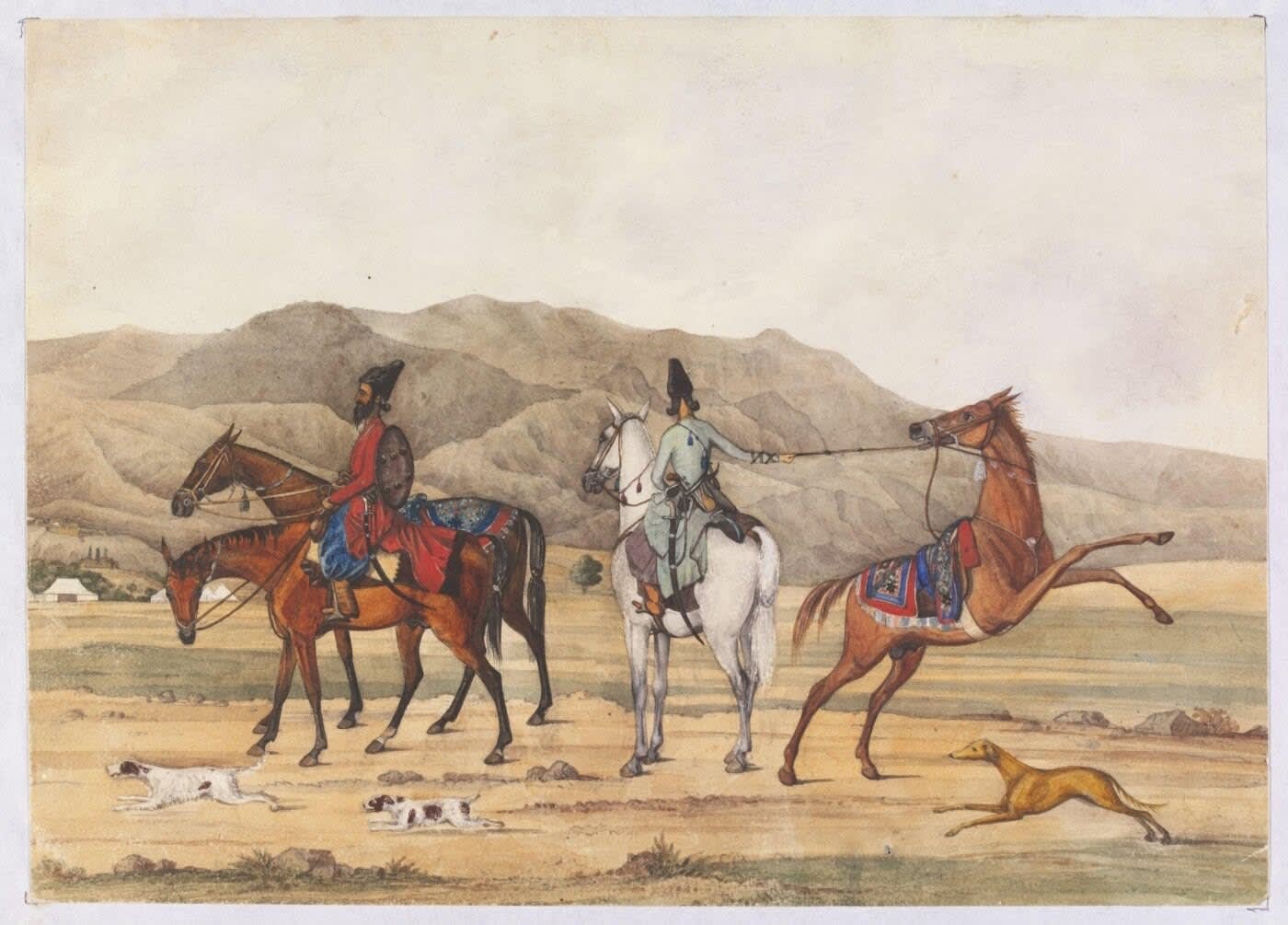
A rare watercolor with horses distinctly labeled as “Arabians and Turkoman Horse the property of Sir J. C - - with Persians”, Painted August 3, 1833 by Godfrey Thomas Vigne during Sir J. Campbell’s envoy work in Teheran (Victoria and Albert Museum, 2026). 📜
The difference in anatomy can be noted for the slender Turkoman horse behind his handler. During this time, diplomats (like Sir J.C.) often collected or were honored with such horses as symbols of political alliance and prestige. Turkoman horses were highly traded in the 19th century and especially prized by Imperial Persia for their military might and breeding value. In fact, the Persian “Kauserooni” breed is believed to have been produced by crossing strength and speed of Arabians with Turkomans (Potts, 2025). Today, Akhal-Teke descendants of the Turkomans still offer this heritage blood and refinement for other breeds.
Victoria and Albert Museum, 2026. https://collections.vam.ac.uk/item/O152882/arabians-and-turkoman-horse-the-watercolour-vigne-godfrey-thomas/
D.T., Potts, 2025. “The Best Thing that Persia Possesses: European Views of Persian Horses throughout the Ages”, 5(1). Cheiron: The International Journal of Equine and Equestrian History.